

As climate-related risks continue to reshape the global economy, investors are placing increasing emphasis on understanding how these dynamics affect financial markets. Contrary to earlier expectations that sustainability considerations might recede in uncertain environments, recent surveys of global asset owners indicate that climate risk remains a central concern for long-term investors[1].
In this context, strengthening the link between academic research and financial practice has become essential. By fostering collaboration between researchers and practitioners, it is possible to deepen the understanding of complex phenomena and to translate this knowledge into more robust investment approaches.
This objective lies at the heart of the partnership between Candriam and KEDGE Business School, supported by the Candriam Institute for Sustainable Development as part of its commitment to advancing sustainability education.

Launched in 2019 and renewed in 2023 for another four years, the KEDGE-Candriam “Finance Reconsidered” Chair brings together academic expertise and market experience to explore key questions related to ESG integration, asset pricing, and the financial implications of climate change. Over the years, the Chair has generated a significant body of research, including academic publications, white papers, and educational content. These outputs contribute to a better understanding of how sustainability factors influence financial markets and decision-making.
Christoph Revelli, Full Professor of Sustainable Finance and Impact Investing, KEDGE-CANDRIAM Finance Reconsidered, is one of an increasing number of experts emphasising how the acceleration of climate change impacts financial institutions through aspects such as credit risk, reputational risk, stranded asset risk, insurance indemnity risk. Thus, it also impacts economic stability. He noted that incorporating these risks, regardless of asset class, should help identify potential financial losses and the opportunity to strengthen the financial system’s resilience to climate shocks.

The assessment of climate risk, whether physical or transition-related, has become essential to financial decision-making, given its materiality. … Asset managers are essential for overcoming these risks, with the expertise and skills they bring in the integration of climate risks into the risk management modeling and assessment model. They are also key to identifying the assets which have more resilient business models due to their climate commitment.
Advancing Understanding of climate risk in fixed income markets
One of the recent areas of focus of this collaboration is the analysis of climate risk in corporate bond markets. While sustainability considerations are often associated with equities, bonds are also exposed to climate-related risks.
Research conducted within the framework of the Chair has explored how these risks can influence bond performance. A central concept is that of “climate sensitivity”—or “climate beta”—, which looks at how the value of a bond may react to climate-related developments, such as new regulations or changes in investor expectations.
One important finding is that what may appear as protection against climate risk is not always what it seems. In some cases, bonds seem resilient not because the issuing company is better prepared for climate challenges, but because their performance is influenced by broader market factors, such as interest rate movements. This means that investors need to look more closely at what is really driving returns.
Corporate bond investors face a fundamental challenge, namely, measuring a bond's true sensitivity to climate risks requires choosing among many competing climate indices.
These insights highlight the complexity of integrating climate considerations into investment decisions, and the importance of using careful and transparent methodologies.
From Research to Practical Application
Turning research findings into practical tools is a key objective of the partnership. Sharing these insights with clients and stakeholders can help them better understand how climate risk can affect investment outcomes. This was the aim of a recent client event held by Candriam to present the findings of the research paper “Climate Beta Uncertainty in Corporate Bonds” by Ricardo Henriquez-Salman, KEDGE Business School/ Aix-Marseille University. This was also the opportunity to share how Candriam approaches creditworthiness assessment based on both physical risks and transition risks covering Scope 1, 2, 3 emissions.

Academic research can assist financial practitioners by highlighting the bigger picture on issues. This allows us to be aware of considerations that were not necessarily on our radar. Joining these together helps us provide more rounded, holistic solutions for our clients.
Supporting a more resilient financial system
By encouraging collaboration between academia and the financial industry, initiatives such as the “Finance Reconsidered” Chair contribute to building a more resilient and forward-looking financial system. They enable the development of more sophisticated analytical tools and foster a deeper understanding of how sustainability factors influence financial performance.
For the Candriam Institute for Sustainable Development, this partnership reflects a broader commitment to supporting education and knowledge-sharing as key levers for positive change. By investing in research and training, the Institute aims to equip both current and future professionals with the insights needed to address complex sustainability challenges.

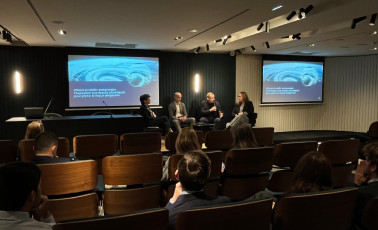
Candriam client event, How Uncertainty About Climate Risk Influences Bond Yields, 17/03/2026
[1] Source: FTSE Russell Insights, Climate concerns still top of mind for investors | LSEG