
Some entrepreneurs build businesses. Others set out to change the way society works. On World Entrepreneurs’ Day, we celebrate the people who see a problem that has become accepted as inevitable and decide that there must be another way.
Every year on 21 August, World Entrepreneurs’ Day celebrates the ideas, determination and creativity that turn ambition into action. It is also an opportunity to look beyond the traditional business world and recognise those using innovation to tackle some of society’s most persistent challenges.
For social innovators, success is not simply about creating something new. It is about making life better: challenging systems that exclude people, finding new ways to meet unmet needs and turning bold ideas into solutions that can last. This belief has been at the heart of Ashoka for more than four decades.
Founded in 1980, Ashoka searches for social entrepreneurs with ideas capable of creating systemic change. Its ambition is summed up in a simple vision: a world in which everyone can be a changemaker — with the confidence, opportunity and resources to contribute to positive change.
Today, Ashoka’s global community includes more than 3,900 Fellows and spans more than 95 countries . In Belgium, the organisation identifies promising social entrepreneurs and accompanies them with financial support, expertise, mentoring and a network of people who can help their ideas grow. The Candriam Institute for Sustainable Development is proud to support this work.
What does it mean to be an Ashoka Fellow?
An Ashoka Fellow is not simply the founder of a successful social initiative. Fellows are selected because they are rethinking the underlying system around a social or environmental problem. Ashoka looks for people with innovative ideas, a strong entrepreneurial mindset and the potential to make their solutions work far beyond one organisation or one community.
Once selected, Fellows join Ashoka’s lifelong network and receive tailored financial and strategic support to help increase their impact.
Two organisations that benefit from fellowship and the support of the Candriam Institute are highlighted below.
Casa Legal: a holistic approach
Someone facing a legal problem may also be experiencing housing insecurity. A family dispute can be connected to financial hardship. Migration questions, domestic violence, employment problems and emotional distress can all intersect. Someone facing several legal problems may also be experiencing housing insecurity. A family dispute can be connected to financial hardship. Migration questions, domestic violence, employment problems and emotional distress can all intersect. Yet support systems are often fragmented, and many people do not find their way to justice.
Casa Legal was created to offer another way. Co-founded by Katia Melis, it became Belgium’s first non-profit law firm, bringing lawyers, social workers and psychologists together under one roof so that people can receive coordinated support rather than navigating a series of disconnected services.
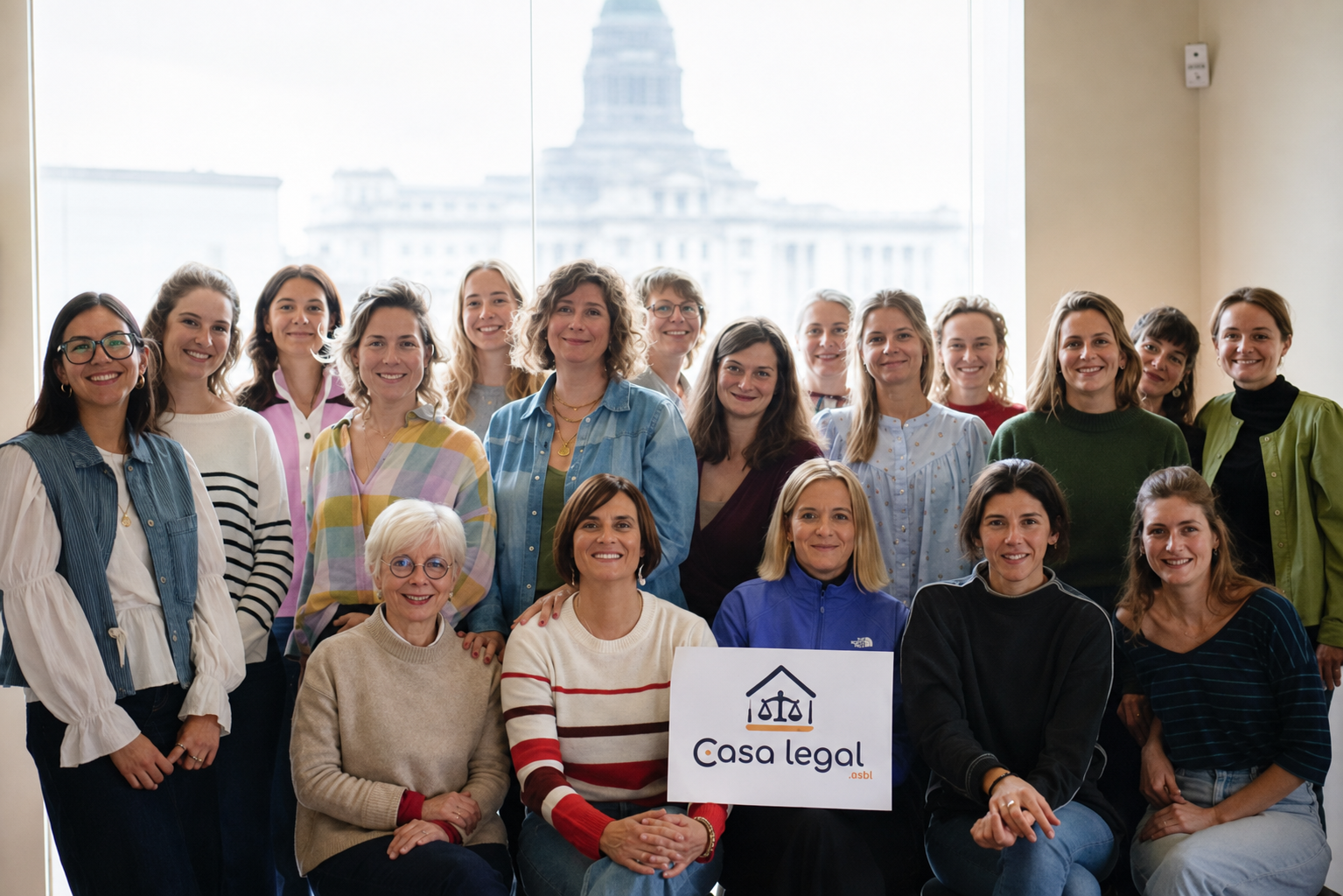
The Casa Legal team
The scale of that need is considerable. In 2025 alone, Casa Legal supported more than 1,100 people in front-line orientation services, facing challenges including migration, domestic violence and housing crises. The organisation has also provided free legal aid to more than 500 individuals since inception.
What matters to us is being able to look at the person as a whole, rather than treating one legal problem in isolation. The support from Ashoka and Candriam gives us access to people, expertise and networks that can help us strengthen that approach — and work towards change that reaches beyond the individual cases we see every day.
Through Candriam’s support for Ashoka, Casa Legal has also been able to provide free legal expertise, as well as greater media visibility, introductions to potential funders, the Ashoka support network and practical resources for its advocacy work.
The objective is not simply to help more people navigate a difficult system. It is also to ask whether the system itself can work differently.
Fondazione Tetrabondi ETS: creating places where everyone belongs
That same desire to rethink established models lies behind the work of Valentina Perniciaro and Tetrabondi ETS as a part of a fruitful, ongoing collaboration supported by Candriam and Ashoka. The Foundation’s work begins with a simple question: what would our public spaces look like if they were designed for everyone from the very beginning?
The Foundation’s work includes the development of Universal Inclusive Parks — spaces designed around the reality of human diversity, where children and adults, with and without disabilities, can play, meet and participate together with greater autonomy. Rather than adapting an existing environment after the fact, inclusion becomes part of the blueprint itself, guided by the principles of Universal Design. Fondazione Tetrabondi addresses not only architectural obstacles, but also the often-invisible sensory, cognitive, communicative and cultural barriers to participation. A key pillar of this approach is Inclusive Wayfinding.
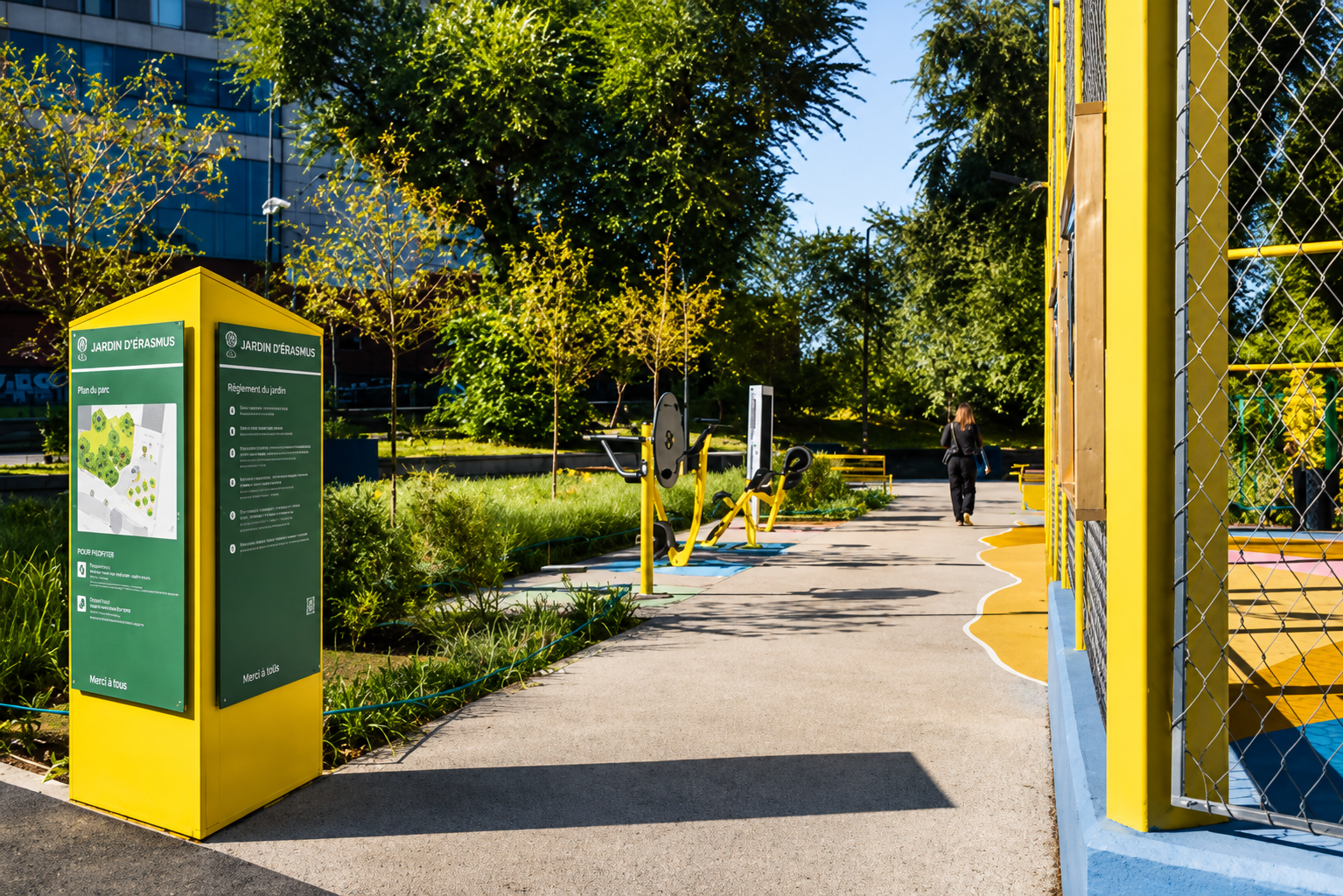
Pepe Borsieri Garden, Milan, where the Foundation’s accessible totems and signage are already in use.
By integrating Augmentative and Alternative Communication (AAC), Italian Sign Language (LIS), tactile indicators, high-contrast visuals and smart technology, the Foundation aims to make public spaces easier to navigate and safer for everyone. This approach can help reduce anxiety and sensory overload for a wide range of users — from neurodivergent people and children to older people and international visitors facing language barriers. The Foundation recognises that achieving absolute, universal accessibility across every potentially conflicting need is an extremely complex challenge. Through intelligent design, however, it aims to create environments that are as welcoming, accessible and conducive to autonomy as possible. This goes beyond traditional notions of accessibility: it is about participation, dignity and a genuine sense of belonging.
For us, true accessibility is not a retroactive favour or a special adaptation for a few — it is the core of Universal Design. We want to build spaces and cities where nobody feels like a guest. Through Inclusive Wayfinding, a park or a square becomes immediately readable, reducing anxiety and stress for anyone, from a person with a sensory disability to a foreign tourist. When you design for human diversity from day one, you don't just eliminate barriers: you create autonomy, dignity, and real freedom for everyone.
Ideas that can travel further
World Entrepreneurs’ Day is a celebration of people willing to imagine something different — but also of what happens when those ideas receive the support they need to grow.
Casa Legal is showing how legal assistance can become more human and more connected. Fondazione Tetrabondi is asking us to rethink who our public spaces are designed for.
Different challenges, different countries, different models — but the same belief that systems can be changed to serve everyone.
Candriam’s partnership with Ashoka is designed to support that journey. Rather than funding one isolated outcome, it helps sustain the wider ecosystem around social entrepreneurs: combining direct support for Fellows with expertise, networks and a community capable of helping strong ideas travel further.
And perhaps that is what social entrepreneurship ultimately gives us: not only solutions to the problems in front of us, but new ways of imagining what could come next.